
Whitepaper The eBMC as an Implementation Tool for the Innovation Architecture
The innovation turbo
We started a trial once and filled the results from the innovation architecture into the eBMC. And lo and behold, now we had a stable basis on which to derive innovations, directions and measures; almost like in a real strategy.
That works as follows:
The innovation architecture as a basis for the delimitation of strategic focus areas
The «innovation architecture» serves to increase innovation success while taking social trends and the use of new technologies into account, by enabling simultaneous consideration or coordination of market, product and technology aspects.
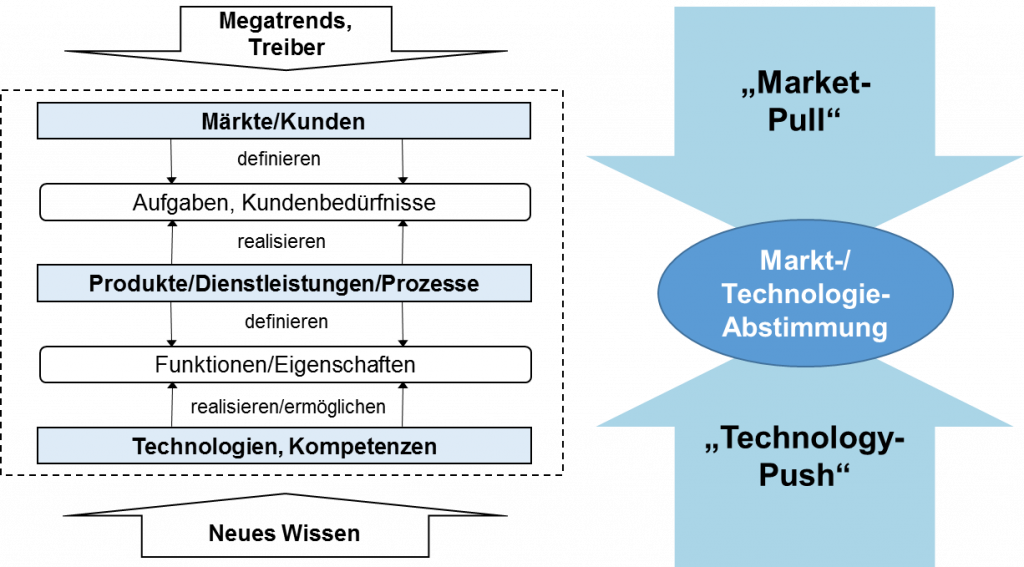
The various levels of architectural observation are logically linked from both the market and the technology point of view and are mutually dependent: On the one hand, trends affect the markets and the behavior of current and potential customers. In concrete terms, the influence of trends is expressed in specific customer tasks and needs. Satisfying these is the primary objective of shaping the market offering, i.e. products, services or business models. In order to provide this service, you need to click on of the other side requires competences or technologies. They fulfil – abstractly formulated – those functions which are necessary for the satisfaction of the customer needs are necessary.
For a Approach «from the market «, in marketing also known as «Market Pull«, we therefore try to optimize our own market offer as much as possible. to meet the needs of the markets. An essential feature of this The point of view is that the customers you want to serve are at least are known to the public to some extent. When looking at «from the technology or Competence her«, also known as «Technology Push«, this is not the case. must be the case. Rather, the question is in the foreground here which Needs in new markets on the basis of available competencies could be satisfied.
If one now fills the individual levels of the «innovation architecture» with concrete content, one obtains a suitable basis for deriving so-called «strategic focus fields» for innovation. In a somewhat abstract formulation, these are search fields for raising innovation potentials, which serve as a source for new market services or offers over a longer period of time. Within these fields, active search is now made for innovation opportunities and solutions are sought . Or something more concrete: Fields within which a company wants to innovate.
The limitation of a strategic focus field is not absolute, but it gives every company a framework to increase the chances for successful innovations and to minimize the risks.
What do we do with the result?
The identification of strategic focus areas forms the basis to fill the eBMC:
- We can create one eBMC per focus field or combine several of them. The prerequisite is that at least one business idea can be created from this.
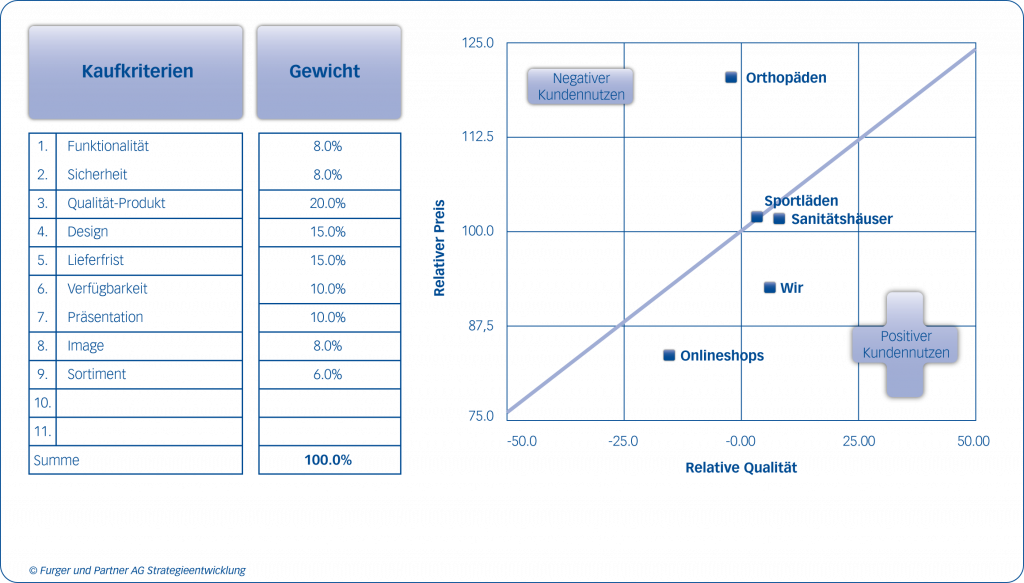
- Then we put together the customer criteria on the one hand. For this we use common KN tools, such as the Kundennutzenanalyse or the Value Proposition Canvas (VPC). The evaluation of customer problems – customer needs – customer benefit criteria helps to precisely define and define the offer from the market point of view.
- On the other hand, we capture all the key technologies necessary for this.
- The description of the product or offer is a derivation from customer benefits and technologies. It is the solution for which the customer is willing to pay. This solution now has not only any derivation, but is strategically embedded, or in English: we have a «STRATEGIC FIT».
- Now we have to fill in the remaining fields of the eBMC, either with already existing elements or with new ones that have to be created. We recommend that new elements be highlighted in color. Immediate measures can then be derived directly from this.
- Now we embed the result into the corporate strategy and define the options, directions and measures, and the recipe is ready.
The procedure step by step
Step 1: Creating the innovation architecture
When creating the innovation architecture, the aim is to fill the above-mentioned levels with concrete content that is relevant for your own company. The following procedure has proven itself:
- Initial filling of the individual levels: This is done by collecting existing analyzes from the market and technology perspectives and comparing them with the corporate strategy.
- Complementary strategic innovation analyses to close remaining gaps in the innovation architecture: This can be achieved through partially standardized interviews with management and key persons from the areas of market, technology and product. On the other hand, targeted analyses are carried out along structured work instructions. These serve, for example, to determine the company’s own core competencies, future customer requirements, relevant megatrends and their consequences, as well as new Technologies with relevance for the company.
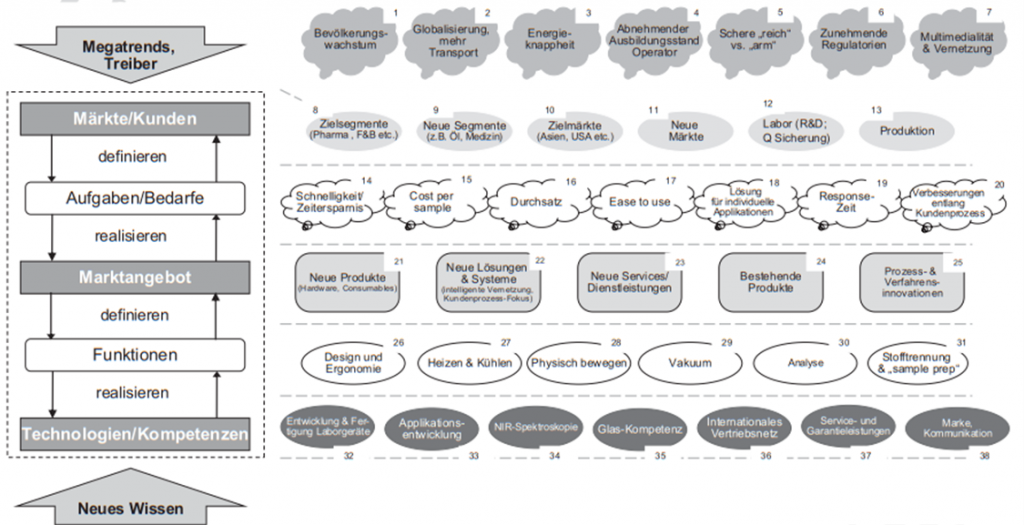
- Setting up the innovation architecture: The results obtained are continuously assigned to the individual levels of the innovation architecture until the picture is complete from the point of view of the core team. The art is to find a granularity suitable for further processing – not too generic, but also not too detailed. Results consisting of 40 to a maximum of 70 elements have proven themselves in practice.
Before further work is started, the innovation architecture should be adopted by the management as a suitable basis for the next steps. This includes a check of the completeness and quality of the content as well as of the granularity. The following figure shows an approved innovation architecture of a manufacturer of chemical laboratory equipment:
Step 2: Identification of strategic focus areas
To identify and delineate a strategic focus, a single content, such as a trend, is selected from the innovation architecture, which, from the company’s point of view, opens up opportunities for differentiating innovations. This content then serves as a «driver» or «nucleus» for the strategic focus field. Each content can already be seen as a strategic focus field on its own or, if necessary, supplemented by further contents from other levels, which should sharpen the task in a suitable manner. Since the demarcation of strategic focus areas should be in line with the corporate strategy, appropriate content should already be incorporated here. This procedure is repeated until the most attractive strategic focus areas have been identified. A number of five to a maximum of ten strategic focus areas has proven to be appropriate. The most important facts about each focus field are summarized in a profile.
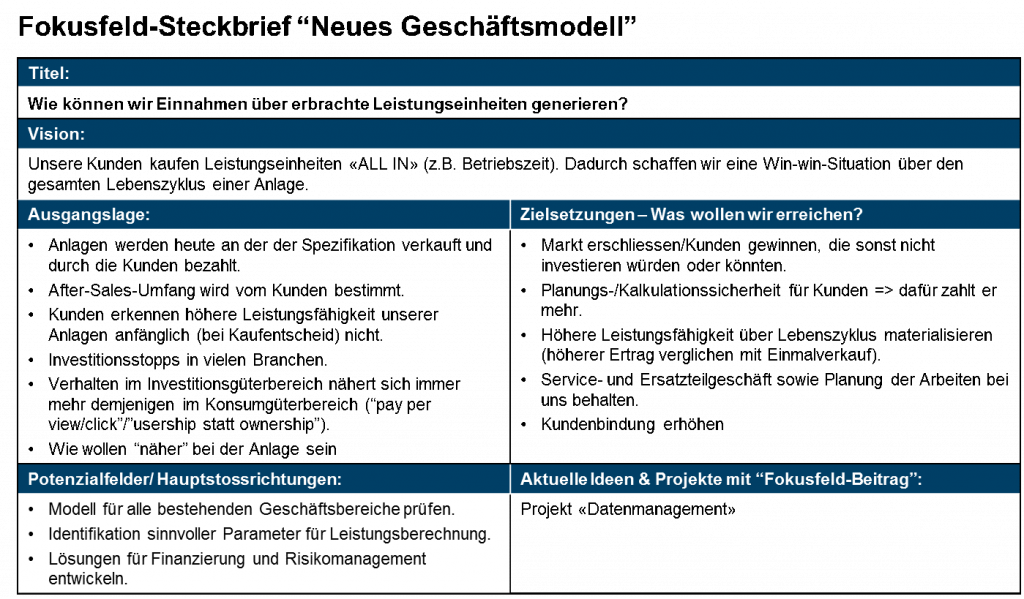
Depending on the content of the focus fields, we then either enter the eBMC via the customer problem or the technology.
Step 3: Solution-independent customer problem and solution technologies
As part of a first «exploration» of the focus areas, it is about sounding out possible innovation potentials. This primarily includes the concretization of solution-independent customer problems in the sense of articulated or inarticulate customer needs. In doing so, it is possible to fall back on proven methods of innovation management in the early stages. Possible meaningful approaches include: lead user workshops with selected customers and sales partners, customer process analyzes, customer observations, in-depth interviews with customers, critical event method (CIT), frequency relevance analysis of events / problems and complaints, internal ideas competitions, open innovation Activities (eg public competitions), benchmarking days, business model confrontation or trend scouting. These are entered in the corresponding field of the eBMC. At the same time – as far as possible – ideas for solution technologies are developed and also recorded in the eBMC. Here, too, can be built on proven methods and concepts such as the S-curve, the Gartner hype cycle or technology radars.
Step 4: Customer Groups and Products
In the next step, the idea will be given further contours by, on the one hand, sharpening the profile of potential customers and, on the other hand, putting the offer together. Osterwalder’s «Value Proposition Design» approach provides valuable assistance in this regard. He assumes that the customer profile can be derived from the «jobs-to-be-done» of the customer as well as the pains and gains in the fulfillment of the tasks. From the considerations to possible «pain relievers», so solution elements for the reduction of the Pains and «Gain-Producers, so solution elements, which are able to donate a customer use, finally the product can be designed. By a product we mean everything that the company «produces» and donates to the customer for money. This includes haptic products, services, services and everything that is today called New German word creations such as «value proposition», «value proposition» and other terms
Complete the remaining fields for the eBMC
On the basis of technologies, customer benefit and offer, the other fields of the eBMC are filled up according to the already classic pattern.
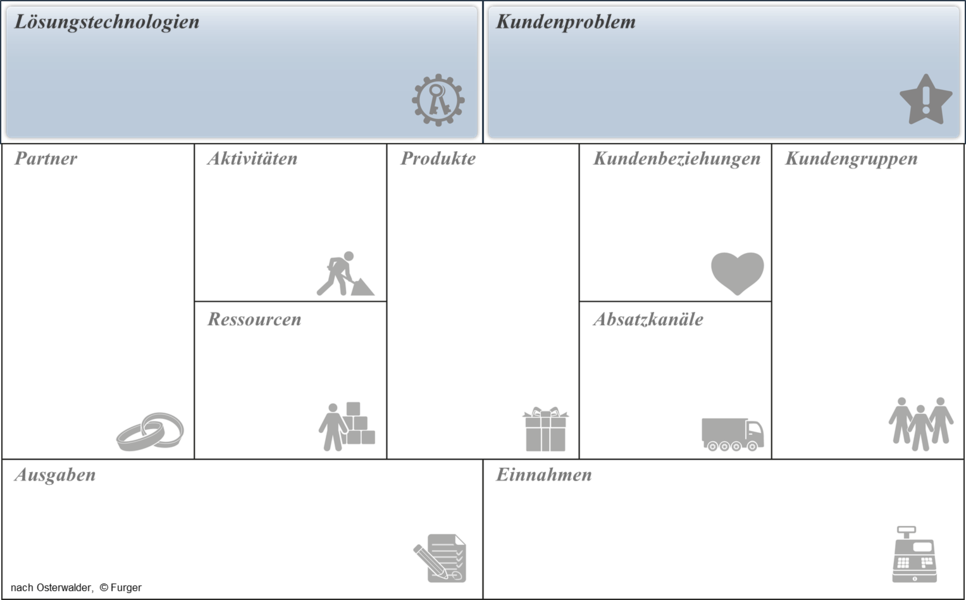
Step 5: Partners, Resources, Activities
No company is alone in the market. List the partners you work with here. This is best done along the value chain; So from the purchase of materials and services on the service to sales; Marketing and communication with the customers, also record the services provided by the partners.
The resources used to create the market offer the following categories: the physical resources (premises, production machines), the intellectual resources (knowledge, patents, partnerships, customer base), the human resources (employees) and the financial resources (available capital, securities).
The key activities describe the processes and competencies needed to ensure service delivery. Again, we cover the entire value chain, which we serve from – to marketing and sales.
Step 6: Customer Groups, Customer Relationship, Sales Channels
Customers can often be divided into groups or segments. In many cases, segmentation also serves for the division into business segments. We recommend equal quantification of these groups, i. with which groups which turnover or even better, which profit is achieved. A good instrument for this is the classic ABC analysis.
The customer relationship also determines the communication with the customer. Between intensive collaboration e.g. There is a whole range of possible relationships with joint developments and pure marketing of the products. Depending on the intensity of the marketing is adjusted accordingly
The sales channels determine how the products or offers come to the customer. Distribution, online channels and points of sale form the interfaces of a company to the target customers.
Step 7: Expenditure
The most important cost factors of a business model are summarized here.
Step 8: Revenue
Here, pricing models and pricing strategies (one-time payment, subscription) are described.
Step 9: Integrate the innovations into the corporate strategy
We can now directly derive the measures from the eBMC for the implementation. If we have highlighted the «new» elements in color, they can easily be formulated.
Alternatively, we can now embed the result in the corporate strategy and develop options, strategic directions with quantitative targets. These then lead to concrete measures and form part of the strategy that will be implemented and accompanied by strategic controlling.
eBMC in the STRATEGY.APP
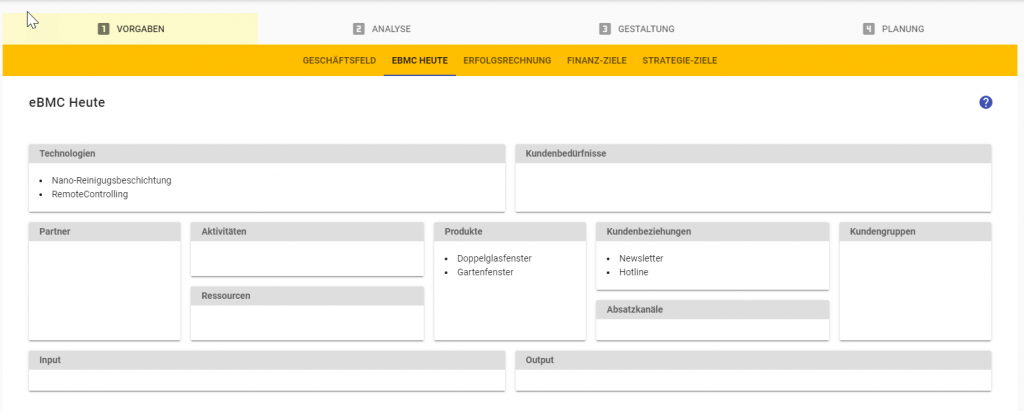
For each business area, we create the eBMC with the current key elements. Each module is filled accordingly and can be adapted, printed or otherwise communicated at any time:
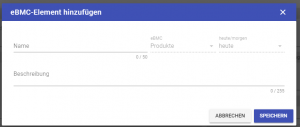
The individual blocks and elements are entered in the usual editing window:
In the design phase, we can now add additional key elements; here e.g. as a new technology, the «nanotechnology» applied to the coating of the glass; or a new sales channel with which customers will be served in the future:
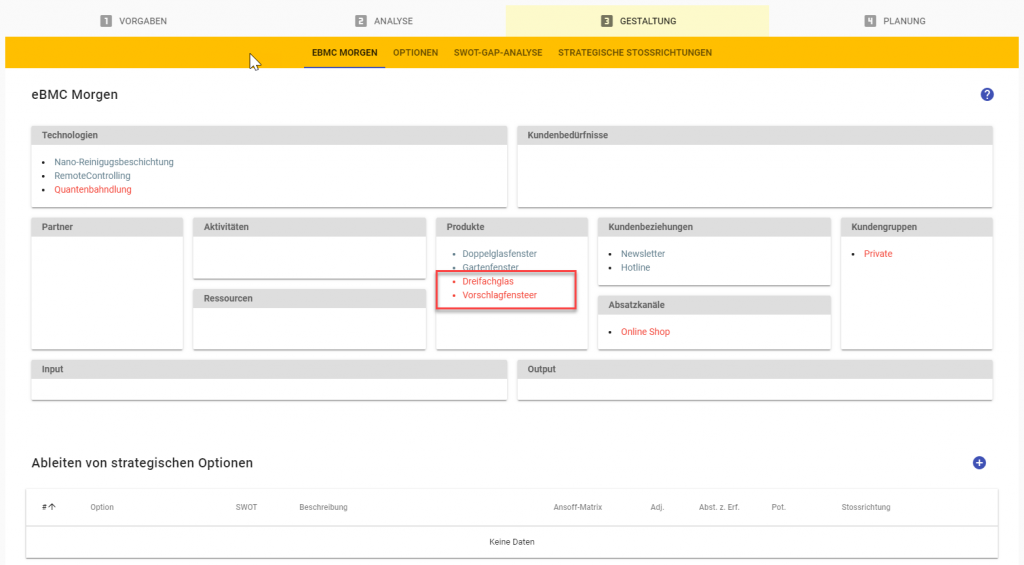
The new elements appear in red for identification. This provides us with a basis for deriving new strategic options and developing strategic directions and measures.
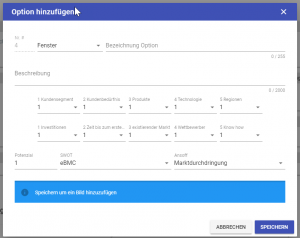
These are then listed in parallel with the options derived from the SWOT.
Here, too, options can be added, added, stopped or deleted at any time.
Literature: « Wunderwaffe Innovation «By Beat Birkenmeier and Harald Brodbeck
Learn more about « Innovation Architecture » at:
beat.birkenmeier@gronova.com +41 41 727 04 70
White Paper: Strategic Success Potentials in Times of Disruption
Part 1 of 2
Just as operational management has its controlling or core figures in annual or quarterly earnings figures, so too does its strategic management. The most important control variables here are the market position, the cost position and the customer benefit. Add to this the handling of new technologies and here come S-curves and disruption into the game. The interplay of these variables allows us to derive the success potential and thus the future viability of a company.
Download this page as PDF
Strategic success potentials
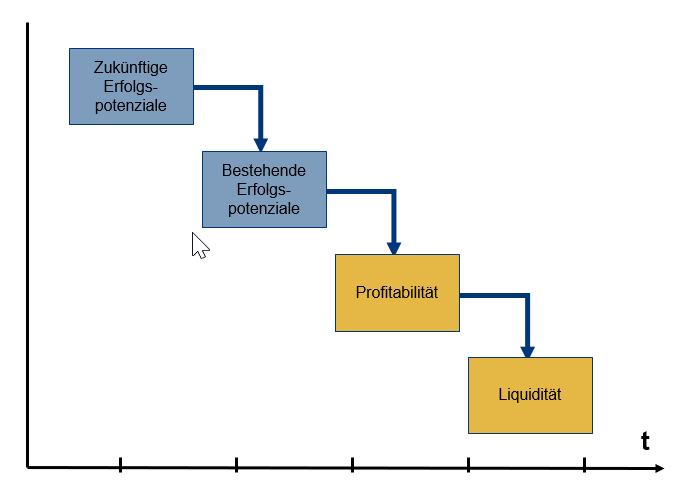
Success potentials are all the prerequisites and abilities of a company, with which the results of the enterprise are achieved. Gälweiler differentiates here by distinguishing between current and future potential for success.
Today’s potential for success
Today’s or existing potential for success forms the basis for the medium-term success of the company. The most important key figures for this are the market position and the cost position. However, these key figures are not sufficiently informative about the long-term success and survival of the company.
Future success potential
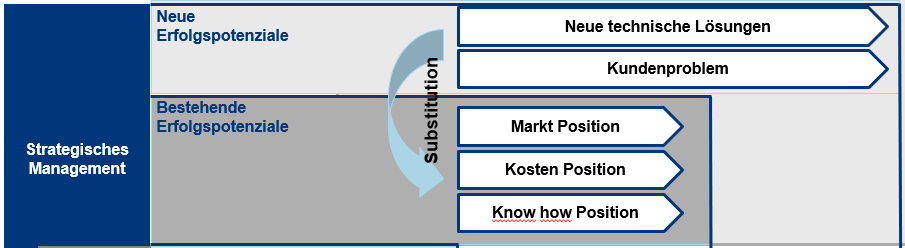
Future success potential ensures that a company can remain successful in the long term. The central control parameters for this are the «solution-independent customer problem» and «new technologies». The building up of future success potentials is attributed to the strategic management. Essentially, the development of future success potentials corresponds to innovation and thus to strategic innovation management.
«Strategic corporate governance as a precontrol task with regard to the subsequent realization of success therefore consists of the search, creation and maintenance of high and secure success potentials, which always includes the timely location of innovation potential.»
(A. Gälweiler, 1987)
The different crises of a company
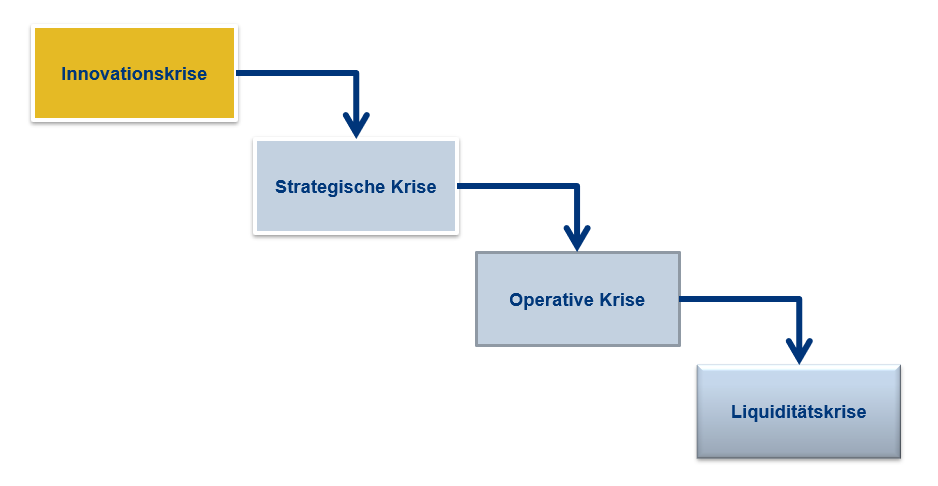
According to this logic, corporate crises can be classified:
- If a company lacks the liguidity, it is technically bankrupt and one calls this the «liquidity crisis». This happens to many startups – although you have good business models and a lot of potential when you run out of money, that’s over
- The operating crisis or earnings crisis occurs when the profit is down or negative. This is not the death of a company. As long as money is there, it can survive and if the strategy is right, it will even be back in the black.
- The strategic crisis is defined by a poor market and cost position. The gain may still be positive, but the future is endangered.
- The innovation crisis will only take effect in a few years, when new solutions based on new technologies begin to substitute our products and services.
Gälweiler on operational key performance indicators versus strategic success factors
Quotes from A. Gaelweiler: Strategic Management, 1987
- The autonomy of strategic corporate management lies above all in its independent orientation. (P. 26)
- The autonomy of strategic corporate management lies above all in its independent orientation (p. 26) Operational business data, as important and irreplaceable as they are for running the day-to-day business, often leaves the actual strategic problems of a business venture in one Light that does not correspond to the real strategic conditions. Therefore results and data of the current business usually lead to a strategically wrong behavior. (P. 25)
- Success data are relatively ineffective and often totally misleading as a basis for strategic corporate governance. (P. 30)
- The signals emanating from the short-lived success data are usually not only too late. Too often, they also mislead to acting in a long-term, wrong-pointing direction without first being noticed. (Pp. 240 f.)
- Last but not least, therefore, the fundamental importance of the strategic management task lies in the fact that wrong decisions and omissions are generally no longer correctable or recoverable if they only become noticeable at the time of the operational implementation of the success data. (P. 26)
The current success potentials and their control parameters
According to Gälweiler, today’s potential for success is derived from the control factors of the cost position and the market position. From our point of view, it is indispensable to include the area of employees as a further position for control variables. Our experience shows that this as a strategic success potential also plays a crucial role.
Market position
The control parameters of the market position include the following factors:
- Absolute market share
- Relative market share (in relation to the 3 biggest competitors)
- Customer loyalty
- Customer Value
- Relative Qualitä
- Image
- entry barriers
These figures show whether your own market position can be maintained and defended, or expanded.
Cost position
The control variables of the cost item are the various types of productivity. The continuous optimization of structures and processes comes into play here:
- Productivity of knowledge
- Productivity of the invested capital
- Productivity of employees
Know-how Position
The active involvement of employees in corporate development releases strong and often unimaginable energies and decisively supports the development of factors such as:
- Know-how
- Core competences
- Motivation and commitment
- Creativity and new ideas
Future success potentials and their control variables
Gälweiler derives the future potential for success from the control parameters of customer benefits and technologies.
Customer benefits
Customer value is the anchor for any corporate strategy; And this is about the original customer problem, detached from the product or offer. We also refer to this as a «solution-independent customer problem». Whether you prefer to call the customer problem a customer request or a customer need, leave it to them. We treat these three terms as synonyms.
Here are the questions:
- What does the customer really pay for?
- For what does he put the money on our counter and not go to the competition?
A detailed description of this topic can be found in our whitepaper «Customer Benefits».
Technologies
All technologies have a limited lifetime because they are replaced by new and improved technologies. There are on the one hand gradual improvements and optimizations of existing technologies, on the other hand quantum leaps, with which a new technology replaces the existing solutions within a short time. Not only does it offer improved solutions, it also offers completely new applications that are better for the customer. These are e.g. the automobile with the internal combustion engine opposite the horse-drawn carriages or the email via the Internet opposite the letter post. As control parameters of the technologies the questions after the
- right key technologies
- the life phase of an existing key technology
- the advent of new technologies
- your own core competencies
- the substitution of existing products and solutions
Disruption and S-curve
Here we find the basis of what is being discussed and treated nationwide under the term «disruption»: the S-curve.
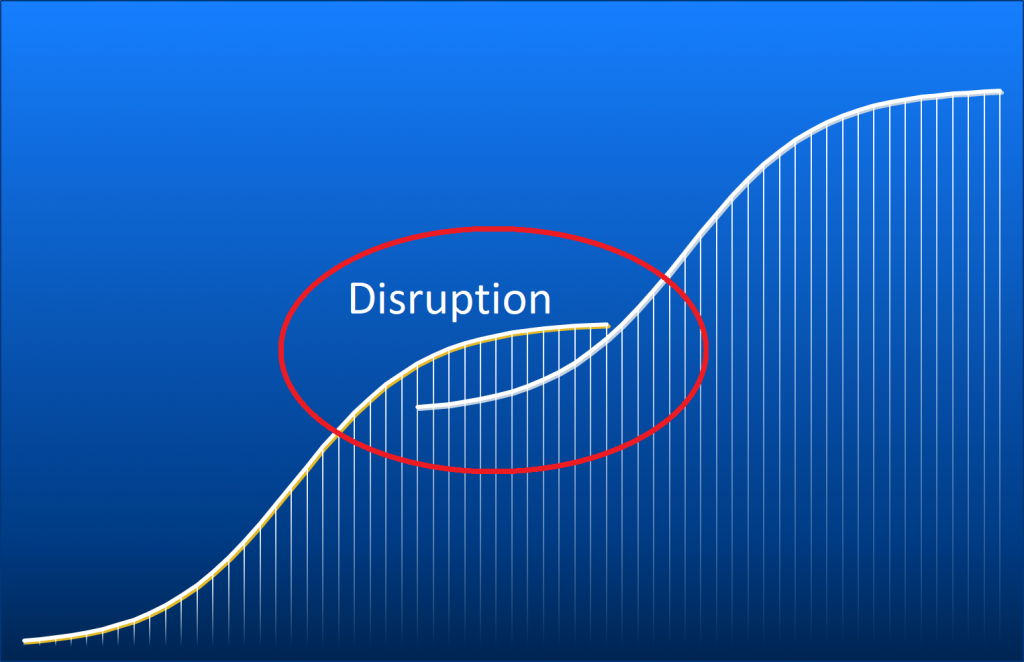
The expiration of a technology while at the same time a new technology spreads, shows the emergence of future success potentials. Existing products are substituted by new offers according to the pattern of the S-curves.
In the next whitepaper, we will discuss it in detail and introduce the S-curve tool in more detail.
Download this page as PDF
Ignaz Furger
Furger and Partner Inc Strategy Development Hottingerstrasse 21 CH – 8032 Zurich +41 44 251 8070 furger@furger-partner.ch www.strategy.app
Strategy Development – The Book
Strategy Guide
Order at www.wekaservices.ch/strategie-leitfaden

This strategy guide is a practical guide to developing business strategies. The concept is based on 20 years of experience that I have acquired in the accompaniment and management of strategic projects with mainly medium-sized companies in Germany and Switzerland. The guide clearly shows how a strategy project is set up and then guides you step by step through the process to the point of preparation for implementation. The book is intended to empower employees to independently develop and implement the strategy of their company.
Employees as strategists
Most corporate strategies emerge in the all circle in top management, often with the support of external Consultant.
Practice shows that a large part of these strategies does not work or only works poorly. They may be well thought out or even brilliant in content, but create massive implementation problems. The reason: they do not reach the heart or the head of the employees. They are therefore understood too little or not at all and thus not supported. The result is misunderstandings and resistance, which must be overcome with great effort to implement the goals. This effort is then debited under the Change Management account.
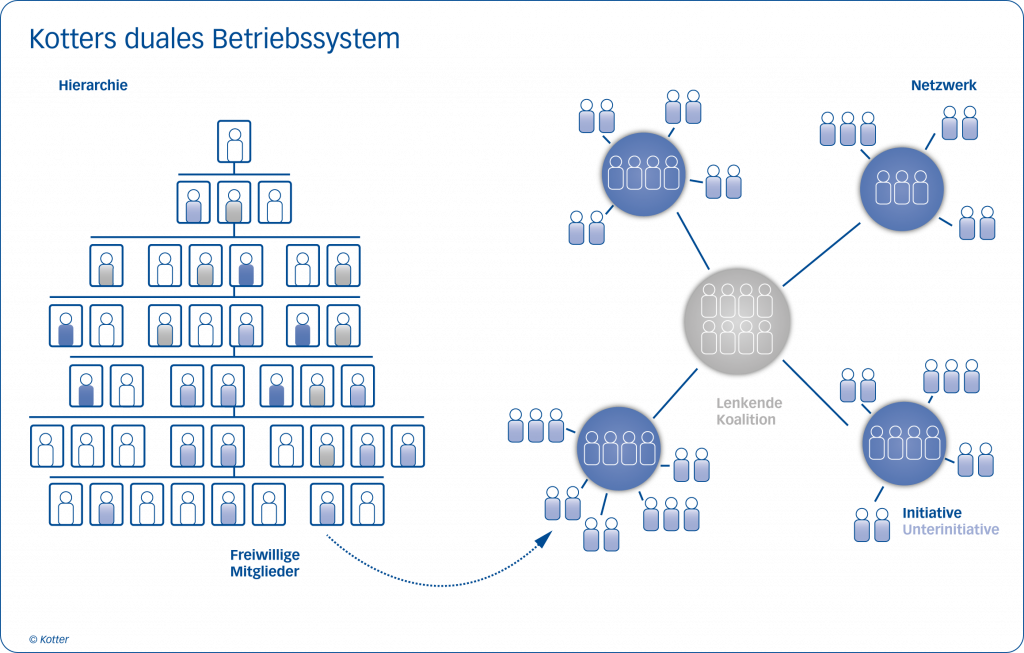
That can be avoided in our experience! By integrating employees into an integrated development approach, the strategy becomes the strategy of the employees, who are then more motivated to implement it – with the positive side effect that strategic competence is simultaneously built up in the company on a broad basis.
Sructure
Basics
Chapters 1 to 3 present just a few theoretical foundations. After looking at different approaches to strategy development, we will discuss some key issues and economic laws. One focus is on professors Hans Ulrich and Aloys Gälweiler. Professor Ulrich, who may be described as the founder of the system-oriented approach, describes a company as an open, productive and social system. From this, the central objective of the strategic work is derived: to promote and ensure the long-term viability of the company.
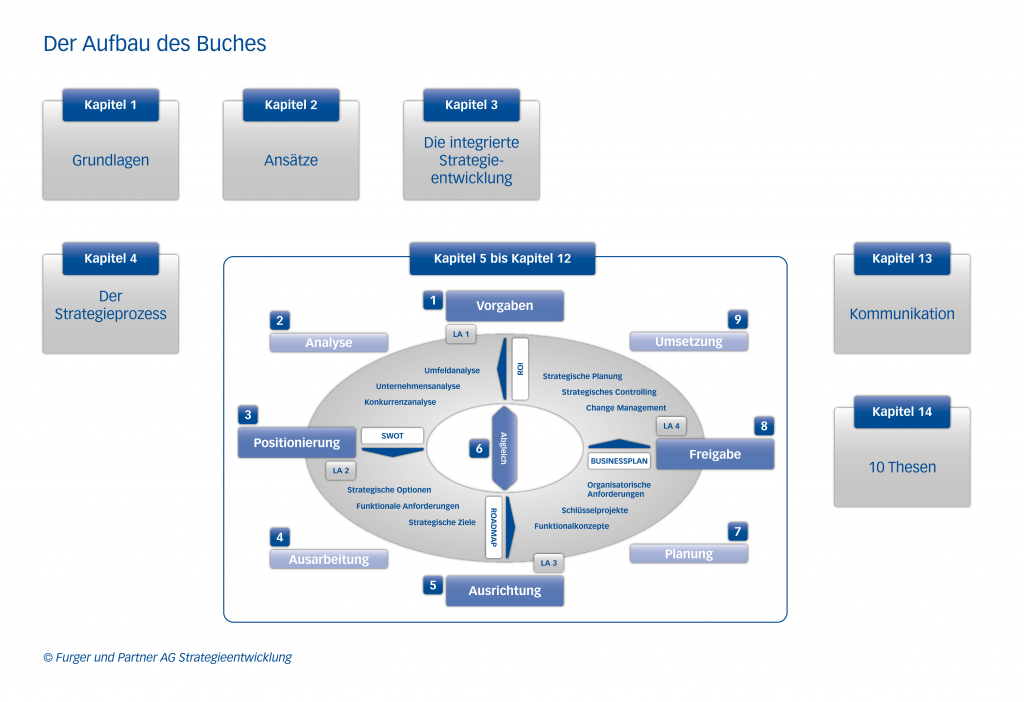
Strategy process
Chapter 4 is dedicated to the strategy development process. As a basis, we present a model of the complementary process that will guide you through the guide as a whole. To this end, we also present possible variants of the overall process, which can be applied depending on the requirements of the company. In addition, it explains which roles are involved in a strategy process and how decisions are made. Hints and advice on organizing meetings and filing documentation complete the chapter.
Guide
Chapters 5 to 12 each represent a step or intermediate step in the strategy process. We describe the procedure and the contents
for the workshops, presenting templates for the agenda and screenplays, and listing each one’s homework. At the end of each chapter the necessary instruments are listed. All checklists, templates and tools can be downloaded from the book’s website. These serve as a template and can be adapted and supplemented as needed. In particular, three aspects are emphasized in this process: the decision-making process between actual project phases, detailed planning of the implementation and the implementation of strategic controlling as part of a separate strategic planning process.
Conclusion
Without going into the theoretical and well-known principles of communication, in chapter 13 we will give you some information about communication based on our practical experience. Our 10 theses titled «Employees are the best strategists» conclude the book with chapter 14.
Electronic Instrumentarium
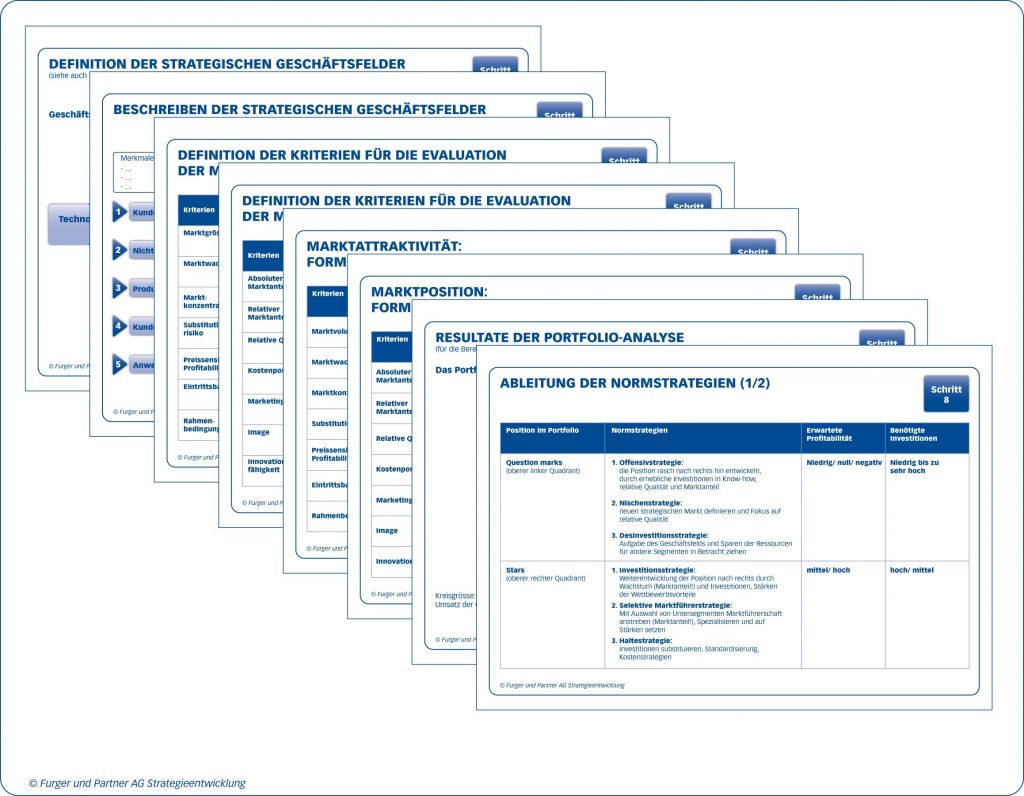
With this guide you will receive a comprehensive set of tools in electronic form that you can download from a book’s own website and use as a working framework for your strategic projects. In addition to well-known strategy tools such as the SWOT, this includes all the documents you need for a project: checklists for the project setup, agendas and scenarios for the workshops, forms and tables.
The instruments are explained in the book just below the immediate application without unnecessary theoretical ballast.
Understanding strategies
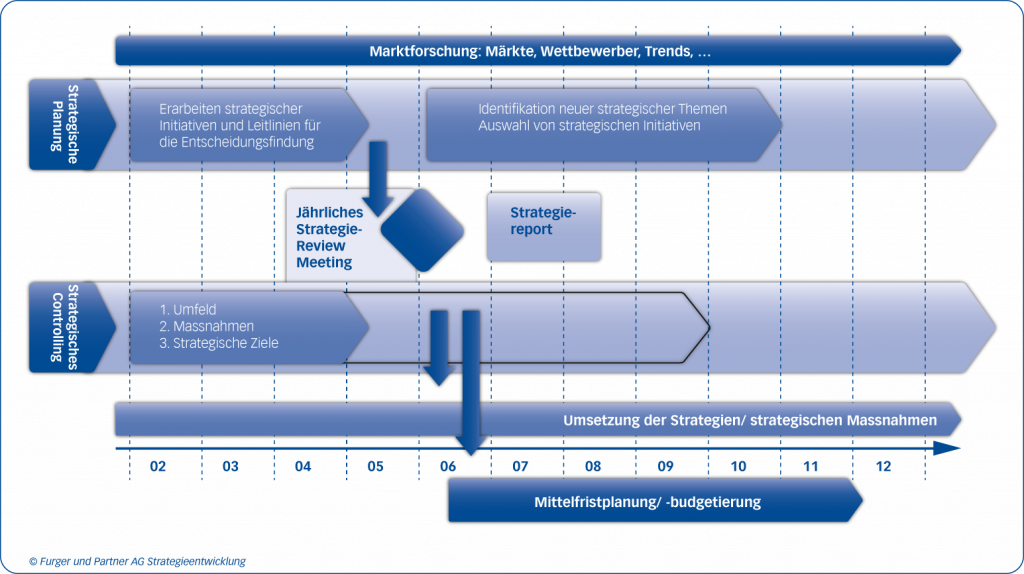
Last but not least, the concept of this guide is that we do not impose rigid instructions and guidelines. Rather, it allows the procedure to adapt both the process and the documents in each case with regard to the specific situation and the requirements of the company. The wide range of instruments and forms is by no means a corset intended to lead to a mechanical execution and filling of forms. The book is intended to teach one thing in particular through its approach: UNDERSTAND STRATEGY.
Order at www.wekaservices.ch/strategie-leitfaden
Reviews – Excerpts:
Bernhard Kuntz, Office for Education & Communication
… A very clearly and systematically structured (work) book, which provides its readers with the necessary tools either to develop strategies for their own company or to design such processes. It is also helpful that the author has placed instructions, forms, etc. on a separate website for all instruments mentioned. From there, readers can download it, adapt it to their needs and use it for their projects. A recommended book!
Prof. Dr. Patrick Eichenberger, Zug / Berlin
… All in all, this strategy guide has produced a highly informative and instructive book on the subject of strategy development, where a proven practitioner and expert in this field not only writes in plain English but also makes convincing attention to numerous shortcomings in this sector. As a university professor in business administration, reading and studying this book has brought me many insights and complementary knowledge of a wide range of tools and brought my knowledge to the sensible and feasible on an updated state of this «strategy consultants guild». Particularly valuable should be the sometimes excellent documents in Power Point, Word or Excel form, which represent in fact a great and highly useful fund of tools. The Strategy Guide has clearly earned five stars in its entirety!
Dr. Pablo Hafner
… With «Strategy Guide» you have all the tools that a professional strategist uses in his daily work. If you own or run an SME, you have the opportunity to design your own business strategy at an affordable cost; a luxury that I at least could not enjoy so far.